Get RateX Pro
 29 Jan 2026
Tokenized Treasuries (RWA) Became On-Chain Risk-Free. What This Changes In Crypto
RWA sounds boring until you see the shift it creates. Tokenized U.S. Treasuries are now a measurable on-chain category, with billions tracked across products on RWA.xyz rather than a one-off experiment.
As on-chain treasury yield matures, it starts acting like a base rate inside crypto infrastructure. The team has seen that once a credible “risk-free-like” yield exists on-chain, capital allocation rules change across DeFi, stablecoins, and risk-on trading.
Why Tokenized Treasuries Matter Now
The core is simple. Historically, the risk-free rate lived outside crypto and entered on-chain only indirectly. Now it is increasingly packaged as an on-chain product with clear mechanics: short-dated U.S. T-bills, a regulated wrapper, tokenized shares, access controls, and redemption flows.
This matters because it changes the benchmark for yield. When capital has an on-chain alternative with treasury-linked yield, DeFi yield expectations get repriced automatically.
The Market Is Already Big Enough To Matter
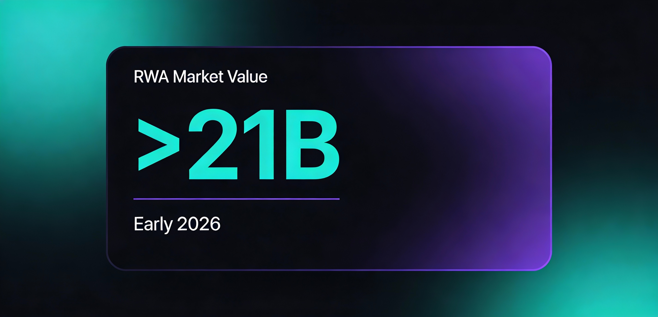
RWA market value exceeds $21B in early 2026
RWA.xyz shows the RWA market at hundreds of billions when stablecoins and cash equivalents are included, while treasuries are tracked as a dedicated product category in their treasuries dashboard.
Two practical maturity signals:
- Market overviews reported tokenized RWAs exceeding $21B in early 2026, with treasuries and gold among key drivers.
- Some large treasury-related products in the sector have reached multi‑billion scale in market cap/TVL as the category expands.
Two Layers: “RWA Yield” And “RWA Plumbing”
There are two different stories.
First is yield. Markets increasingly treat tokenized treasuries as a base allocation when risk appetite drops.
Second is plumbing. Tokenization requires custody, a regulatory wrapper, an issuer, clear access rules, and predictable redemption. This infrastructure determines how close the product truly is to risk-free.
Table. What On-Chain Risk-Free Changes
| Layer | What Changes | Market Effect |
|---|---|---|
| Base rate | An on-chain yield benchmark emerges | DeFi lending/credit yields start competing with it |
| Liquidity behavior | Capital gets a yield-bearing “parking” option | Risk-on/risk-off rotations become faster and more mechanical |
| Risk premium | Risk premium becomes more transparent | Low-quality yield looks worse relative to T-bills |
What This Changes For DeFi And The Crypto Cycle
Once on-chain risk-free exists, the market asks every protocol the same question: why take this risk if a benchmark alternative exists. This does not kill DeFi yields, but it forces them to become more honest.
Cyclically, rotations can intensify. In risk-off, capital does not only move into stablecoins; it can move into “stablecoins + yield” via structured treasury products. In risk-on, capital can return faster when the risk premium becomes attractive again.
Risks. Why “On-Chain” Doesn’t Mean “Risk-Free”
The common mistake is assuming “on-chain means safer.” A big part of the risk is operational and legal.
Key risks:
- Counterparty/custody (who holds the T-bills and how).
- Redemption and exit liquidity (how fast you can exit and on what terms).
- Access constraints (who can hold it; investor requirements; jurisdictions).
- Regulatory uncertainty around tokenized funds/products.
Where It’s More Efficient And Convenient To Read Alpha
When RWA heats up, speed of context matters most. On the site, tracking via tags like RWA / Research and using asset cards helps keep news, on-chain linkages, and market signals in one place instead of stitching it manually.
Conclusion
Tokenized treasuries are becoming the on-chain benchmark for yield.
Tokenized treasuries are not “just another sector.” They are an on-chain benchmark that forces the market to price risk premium more explicitly. If in 2024 DeFi yields were compared to “zero,” in 2026 they are increasingly compared to a real rate, simply packaged as a token.

 06 Jun 2024